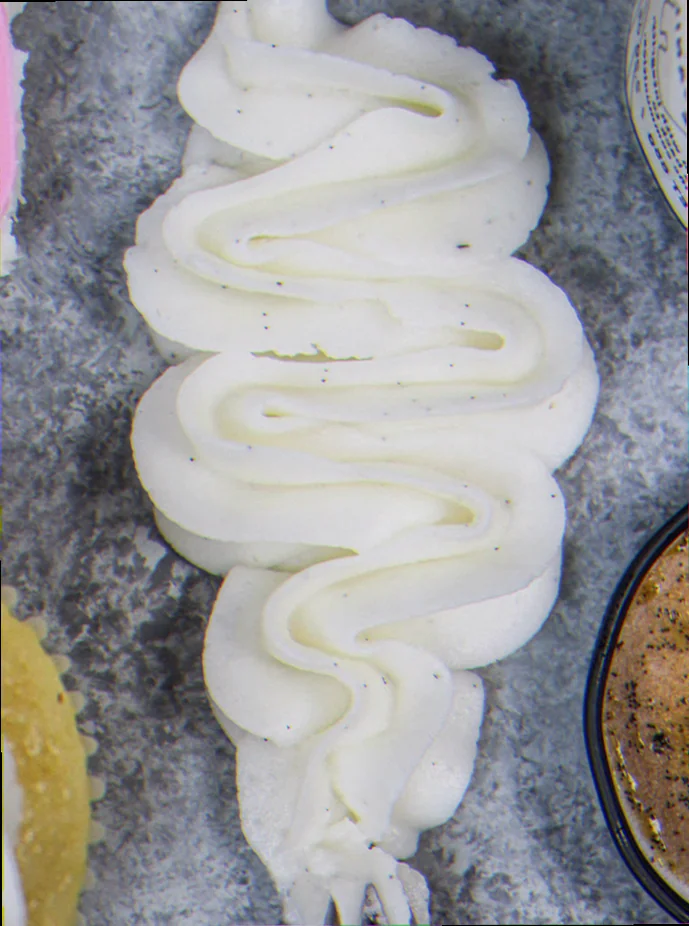
Vegan Buttercream Disaster Guide
Your frosting split, curdled, or tastes like wax? Here’s exactly why—and how to fix it before you throw the bowl across the kitchen.
The most common failure in vegan buttercream is “greasy collapse”—where the frosting starts smooth but quickly separates into a slick, oily puddle on top of your cake, leaving a dense, waxy layer underneath. It looks almost right at first, then weeps fat within 30 minutes, turning your piping work into a sad, shiny mess. This happens because most plant-based fats melt at lower temperatures than dairy butter, and without the right emulsifiers or technique, they can’t hold structure under stress. Below, we’ll diagnose every possible failure mode (from grainy texture to soapiness), explain the ingredient and technique triggers, and give you rescue protocols for mid-disaster recovery.
What Perfect Vegan Buttercream Actually Looks, Feels, and Tastes Like
| Stage | Success Marker — What You Should See / Feel / Smell / Hear |
|---|---|
| Before mixing | Vegan butter is cool (18–20°C) but not rock-hard; it yields slightly when pressed with a finger but doesn’t smear. Powdered sugar is lump-free, sifted through a fine-mesh sieve (no grit when rubbed between fingers). |
| Mid-creaming | After 3–4 minutes of beating, the butter and sugar transform from a dense paste to a pale, fluffy cloud (like whipped dairy butter). The mixer leaves distinct ribbons on the bowl’s sides that hold shape for 2+ seconds. Temperature: 19–21°C. |
| After liquid addition | Emulsion is stable and glossy—no oil pooling at the edges. If you drag a spatula through it, the frosting holds a clean line without slumping. Colour is uniform (no streaks of unincorporated fat). |
| Final texture | Silky but structured: When you press a finger into it, it leaves a shallow indent that slowly rebounds (like memory foam). Piped borders hold sharp edges without drooping after 10 minutes at room temp. |
| Flavour | Clean sweetness with a neutral fat base (no coconut, bean, or artificial aftertaste). Vanilla or other flavourings should taste bright, not muted or “buried” under greasiness. |
The Ingredient Failures — Wrong Choices Before You Even Start Mixing
Greasy collapse (oil separation): caused by using store-brand vegan butter with low lecithin content (e.g., Earth Balance original) or homemade butter substitutes (like coconut oil + water). These lack the emulsifiers (sunflower lecithin, mono/diglycerides) to bind fat and water. → Fix: Use Miyoko’s Cultured Vegan Butter (high lecithin) or Country Crock Plant Butter (contains mono/diglycerides). For DIY, add 1 tsp sunflower lecithin per 225g fat.
Grainy texture: caused by powdered sugar with cornstarch clumps (common in generic brands) or humidity-absorbed sugar (lumps form when stored in a non-airtight container). → Fix: Use C&H or Domino powdered sugar (finer grind, less cornstarch). Sift twice through a fine-mesh sieve (not a colander). If humid, dry sugar in a 100°C oven for 10 minutes before sifting.
Soapy or bitter aftertaste: caused by low-quality vanilla extract (alcohol-heavy or artificial) or alkaline plant milks (e.g., soy or oat milk with pH >7). → Fix: Use pure vanilla extract (35%+ alcohol, like Nielsen-Massey) or vanilla bean paste. For liquid, use unsweetened almond milk (pH ~6.5) or coconut cream (pH ~6).
Flat, dense frosting (no volume): caused by over-softened fat (butter >22°C) or under-aerated sugar (skipping the creaming stage). → Fix: Chill butter to 18°C before mixing. Cream butter and sugar for 5 full minutes on medium-high until visibly paler and doubled in volume.
The Technique Failures — What Goes Wrong During Mixing
Split emulsion (oil pools on top): what it looks like → shiny slick on surface, dense paste underneath. → Caused by:
- Adding liquid (milk, vanilla) too quickly (shocks the fat).
- Using cold liquid (23°C) during mixing.
- Cake layers still warm when frosted.
- High ambient temperature (>25°C). → Fix:
- Chill frosted cake for 20 minutes before final smoothing.
- Work in a cool room (18–20°C) or over an ice bath.
- Add 1 tsp white vinegar or lemon juice to stabilize emulsion (acid tightens fat bonds).
Air bubbles in piped designs: what it looks like → tiny holes or “Swiss cheese” texture after piping. → Caused by: Trapped air from high-speed mixing or whipping after liquid addition. → Fix: After final mix, tap bowl firmly on counter 10x to release bubbles. Use a silicone spatula to press frosting into piping bag (don’t scrape with a spoon).
The Equipment Failures — When Your Tools Are the Problem
Hand mixer vs. stand mixer: A hand mixer can’t aerate enough for stable emulsion (leads to dense, greasy frosting). → Fix: Use a stand mixer with paddle attachment (whisk attachment over-aerates). No stand mixer? Chill bowl 10 minutes every 2 minutes of mixing to prevent fat melt.
Plastic bowls: Retain heat, causing fat to soften mid-mix (triggers greasy collapse). → Fix: Use stainless steel or glass bowls (conduct heat away from butter). Chill bowl 15 minutes before starting.
Wrong piping tips: Wilton 1M or 2D tips require stiffer frosting (add 10% more powdered sugar). Fine tips (e.g., Wilton #3) clog with vegan butter’s higher moisture content. → Fix: For intricate work, chill frosting 10 minutes before piping. Use larger tips (Wilton #6 or #8) for smoother flow.
The Full Recipe — Built Around Preventing Every Failure Above
Ingredients (for 3 cups, enough for 12 cupcakes or 6" cake):
- 225g Miyoko’s Cultured Vegan Butter (18–20°C) — prevents greasy collapse
- 400g C&H powdered sugar (sifted twice) — eliminates graininess
- 1–2 tbsp unsweetened almond milk (20°C) — stabilizes emulsion if added slowly
- 1 tsp sunflower lecithin (if using low-emulsifier butter) — binds fat/water
- 1 tbsp vanilla bean paste — avoids soapiness
- ⅛ tsp salt — balances sweetness, enhances flavour
Method:
- Cream butter and sugar: Beat butter on medium-high (speed 6 on KitchenAid) for 2 minutes until pale and fluffy. Add sugar 50g at a time, mixing 30 seconds between additions. Scrape bowl every 1 minute. Success marker: Mixture clings to paddle in soft peaks.
- Add liquid: Reduce speed to low (speed 2). Add vanilla and 1 tbsp milk, mixing 10 seconds per addition. Critical control point: If oil pools, stop and chill 10 minutes before continuing.
- Adjust consistency: For stiffer frosting (piping), add 10g more sugar. For softer (spreadable), add ½ tsp milk. Success marker: Holds a piped rosette for 30+ seconds without slumping.
- Rest before using: Let frosting sit 10 minutes at room temp to relax air bubbles. Why? Prevents “cracked” surfaces on piped designs.
How to Rescue Vegan Buttercream When It Has Already Gone Wrong
If greasy collapse has happened (oil on top):
- Chill bowl 20 minutes in freezer.
- Rewhip on low speed, adding ½ tsp cornstarch to absorb excess fat.
- If still split, melt 10% of the frosting (microwave 10 sec), then re-emulsify with remaining batch. → Result: 80% recovery—usable for crumb coat but may not pipe sharply.
If grainy texture persists:
- Warm ¼ cup frosting to 35°C (microwave 15 sec), then mix back into batch.
- Add 1 tsp lemon juice (acid dissolves sugar crystals). → Result: Full recovery if caused by sugar; no fix if from under-creamed butter (start over).
If soapiness dominates flavour:
- Unfixable (chemical reaction from alkaline ingredients). Discard and remake with acidic liquid (coconut cream + ½ tsp vinegar).
If frosting is too stiff to spread:
- Fold in 1 tsp warm milk with a spatula (don’t whip).
- Press through a fine-mesh sieve to break up clumps. → Result: Smooth but may lose piping definition.
Make-Ahead: Which Failures This Introduces and How to Avoid Them
| Storage Method | Failure Risk | Prevention Protocol |
|---|---|---|
| Fridge (1–3 days) | Fat crystallization (grainy texture) | Store in airtight container, layer surface with parchment. Rewhip 5 minutes after bringing to 18°C. |
| Freezer (1 month) | Emulsion break (oil separates) | Freeze in silicone molds (not plastic). Thaw overnight in fridge, then rewhip with 1 tsp lecithin. |
| Room temp (6 hours) | Bacterial growth (if using nut milk) | Use coconut cream (stable 24h at 20°C) or pasteurized plant milk. Add 0.1% potassium sorbate for shelf stability. |
Related topics: Vegan pumpkin spice drink recipe · Vegan rosemary bread machine recipe · Mango coconut milk ice cream recipe vegan
Diagnostic FAQ — Real Failures, Real Fixes
My buttercream turned out greasy and slid off the cake—what went wrong?
Failure entity: Greasy collapse. Cause: Butter too warm (>22°C) + lack of emulsifiers. Fix for next time: Chill butter to 18°C, use high-lecithin butter, and add liquid 1 tbsp at a time.
It looked right but tasted like coconut/oil—where did I go wrong?
Failure entity: Fat flavour dominance. Cause: Using unrefined coconut oil or low-quality vegan butter (e.g., palm oil-based). Fix: Switch to refined coconut oil (odourless) or Miyoko’s (cultured, neutral taste). Mask residual taste with citrus zest or espresso powder.
Everything looked perfect until I piped it—why did it curdle in the bag?
Failure entity: Overworked emulsion. Cause: Piping cold frosting (<16°C) or using a small tip with high pressure. Fix: Warm bag in hands 30 seconds, snip tip 1mm larger, and pipe at 45° angle (less resistance).