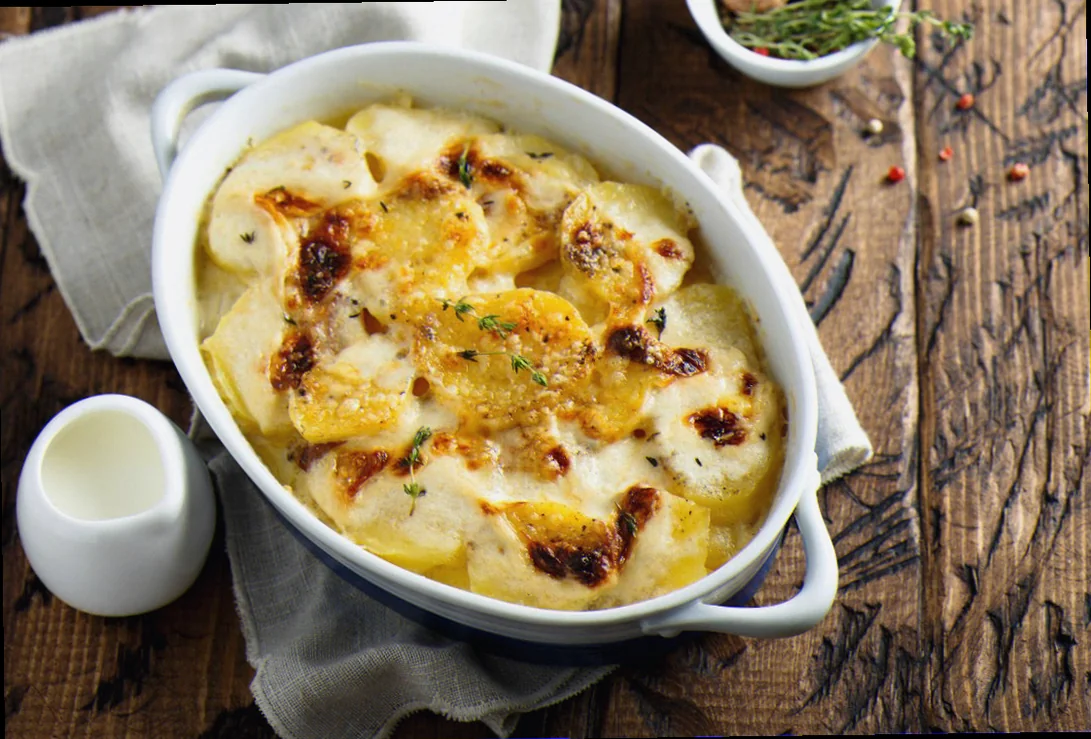
The Dreaded Soggy Bottom: Why Your Vegan Potato Bake Turned Into a Wet, Gummy Mess
You sliced the potatoes thin, layered them carefully, baked them for the recommended time—only to pull out a dish with a top that’s crisp in patches but a base that’s a sad, undercooked slurry. The potatoes at the bottom are mushy, the sauce hasn’t set, and the whole thing collapses when you try to serve it. This isn’t a “moist” bake; it’s a structural failure, and it’s the most common disaster in vegan potato bakes. The good news? Every single failure mode has a fix. Below, we’ll diagnose why it happened, how to prevent it next time, and—if you’re reading this mid-crisis—how to salvage what’s in your oven right now.
What Perfect Vegan Potato Bake Actually Looks, Feels, and Tastes Like
| Stage | Success Marker — What You Should See / Feel / Smell / Hear |
|---|---|
| Before cooking | Potatoes: uniform 2–3mm slices, starchy but not wet to the touch. Sauce: smooth, glossy, and thick enough to coat the back of a spoon (like heavy cream). Layers: snug but not compressed—no gaps, no pooling liquid. |
| Mid-bake (30 min in) | Top layer: golden in patches, edges just starting to crisp. Sauce: bubbling at the edges, no liquid seeping out. Internal temp (probed): ~80°C (176°F)—potatoes should yield slightly to a knife but not fall apart. |
| Finished (60–75 min) | Crust: deep golden-brown, audibly crisp when tapped. Sides: pulled away from the dish slightly. Internal: potatoes hold their shape but are tender; a skewer inserted meets no resistance. Sauce: thickened to a custard-like consistency, no free liquid. |
| Serving | Clean slices that hold together on the plate. Texture: creamy interior with a shatter-crisp top. Flavour: rich umami from nutritional yeast, balanced salt, no raw starch taste. Aromas: toasted garlic, caramelised potato, and a hint of smoky paprika (if used). |
The Ingredient Failures — Wrong Choices Before You Even Start Cooking
- The Gummy Layer Syndrome: caused by using waxy potatoes (e.g., red or new potatoes) → fix: Use only high-starch potatoes (Russet/Burbank or Maris Piper in the UK). Starch breaks down into a creamy matrix; waxy potatoes stay firm and exude moisture, creating a gluey mess.
- Sauce Separation Disaster: caused by store-bought plant milk (too thin) or unblended cashews (grainy) → fix: Full-fat canned coconut milk (13.5%+ fat) OR soaked raw cashews blended with aquafaba (3:1 ratio) for body. Almond milk = watery failure.
- The Bitter, Chalky Crust: caused by nutritional yeast that’s old or low-grade → fix: Fresh, fortified nutritional yeast (we like Bragg or Bob’s Red Mill)—it should smell savory and slightly cheesy, not dusty or sour.
- The Grease Trap Effect: caused by oil with a low smoke point (e.g., olive oil) → fix: Refined coconut oil or vegan butter (Miyoko’s or Flora Plant Butter) for high-heat stability. Olive oil burns at bake temps, leaving a bitter taste.
The Technique Failures — What Goes Wrong During Cooking
The Soggy Bottom (Again): what it looks/tastes like → Potatoes at the base are undercooked, sauce is watery → caused by not pre-cooking the sauce OR skipping the blind-bake for the crust → fix:
- Pre-bake the sauce (simmer for 8–10 mins until it coats a spoon at 85°C/185°F).
- Blind-bake the base layer (if using a crust): 10 mins at 190°C/375°F with pie weights to create a moisture barrier.
The Scorched Top / Raw Center: symptom → Top is blackened but potatoes are still firm → caused by oven too hot OR uneven layering → fix:
- Bake at 175°C/350°F fan-forced (convection) for even heat.
- Layer potatoes in a spiral, not stacked—ensures even cooking. Thickest slices go at the bottom.
The Sauce Break (Curddled or Oily): symptom → Sauce separates into a greasy layer and watery base → caused by acid (lemon, tomato) added too early OR not emulsifying the fat → fix:
- Temper the acid: Mix lemon juice into the sauce off-heat after blending.
- Emulsify properly: Blend cashews + aquafaba first, then slowly drizzle in oil while blending.
The Crust That Never Crisped: symptom → Top layer is steamed, not browned → caused by covering with foil OR not broiling at the end → fix:
- No foil ever. If browning too fast, tent only the edges with foil.
- Broil (grill) for 3–5 mins at the end—watch closely to avoid burning.
The Last-Minute Collapse: symptom → Perfect until you cut it, then it slumps → caused by not resting the bake → fix:
- Rest 15–20 mins out of the oven. The starches retrogradate (firm up) as it cools.
The Equipment Failures — When Your Tools Are the Problem
- The Wrong Dish: Glass or ceramic > metal for even heat. Metal conducts heat too fast, burning the edges before the center cooks. Use a 2–3L/quart baking dish (20x30cm/8x12in). No deep dishes—they steam the potatoes.
- The Dull Knife: Thin, even slices are non-negotiable. A dull knife crushes potato cells, releasing excess starch = gumminess. Use a mandoline (set to 2–3mm) or a sharp chef’s knife.
- The Oven Lie: Your oven’s thermostat is wrong. Test with an oven thermometer ($10). Most home ovens run 10–20°C/50–68°F hot or cold.
- The Saucepan Sabotage: Nonstick pans can’t brown roux properly. Use stainless steel for the sauce base to develop fond (flavor).
The Full Recipe — Built Around Preventing Every Failure Above
Ingredients (Serves 6–8):
- 1.8kg/4lb Russet or Maris Piper potatoes — prevents gummy texture; high starch = creamy layers
- 400ml full-fat canned coconut milk — prevents sauce separation; fat content mimics dairy
- 120g raw cashews (soaked 4hrs or boiled 15 mins) — thickens sauce without graininess
- 60ml aquafaba (chickpea brine) — emulsifier to prevent oil/water split
- 3 tbsp refined coconut oil or vegan butter — high smoke point = no bitter crust
- 3 tbsp nutritional yeast — umami depth; must be fresh
- 1 tsp garlic powder + 1 tsp onion powder — flavor base; prevents “flat” taste
- 1 tsp white miso paste — boosts savoriness (sub: ½ tsp salt + ½ tsp soy sauce)
- ½ tsp smoked paprika — optional, but adds depth
- 1 tsp apple cider vinegar — brightens flavor; add after blending to prevent curdling
- Salt: 2 tsp total (1 for potatoes, 1 for sauce) — undersalting = bland bake
Method:
Prep the potatoes: Peel and slice 2–3mm thick (mandoline ideal). Toss with 1 tsp salt and let sit 10 mins, then pat dry thoroughly — removes excess moisture = crispier layers.
- Success marker: Slices should not stick to your fingers when dry.
Make the sauce: Blend soaked cashews + aquafaba until completely smooth (~2 mins). In a saucepan, heat coconut milk + oil + nutritional yeast + spices to 85°C/185°F, whisking constantly. Remove from heat, then blend in the cashew mixture. Return to heat and simmer 8–10 mins until it coats the back of a spoon.
- Failure prevented: Sauce separation, thin consistency.
- Success marker: Sauce should leave a clear trail when you run a finger through it on the spoon.
Layer the bake: Grease your dish with oil. Layer 1/3 of the potatoes, then 1/3 of the sauce. Repeat, ending with sauce. Press down gently to remove air gaps.
- Failure prevented: Uneven cooking, steam pockets.
Bake: 175°C/350°F fan-forced for 60–75 mins. Rotate dish at 30 mins. At 60 mins, check doneness: a skewer should slide in with no resistance, and the top should be golden and crisp.
- Failure prevented: Raw center, scorched top.
Broil & rest: Switch to broil (grill) for 3–5 mins until deep brown. Rest 15–20 mins before cutting.
- Failure prevented: Collapse when serving.
How to Rescue Vegan Potato Bake When It Has Already Gone Wrong
If the bottom is soggy but the top is cooked:
- Drain excess liquid (tilt the dish over a sink, press gently with a spatula).
- Return to oven at 200°C/400°F for 15 mins to evaporate moisture.
- Result: 80% recovery—texture will be firmer but not perfect.
If the sauce curdled:
- Blend in 1 tsp cornstarch + 2 tbsp hot water, then reheat gently to 75°C/167°F.
- Result: Smooth again, but may lose some richness.
If the potatoes are undercooked but the top is burning:
- Cover with foil, reduce heat to 160°C/320°F, and bake 20–30 mins more.
- Result: Fully cooked, but crust won’t be crisp. Re-crisp under the broiler later.
If it’s a complete disaster (mushy, greasy, or bitter):
- Mash the potatoes, mix with 1 tbsp cornstarch + 2 tbsp plant milk, and pan-fry as potato cakes.
- Use the sauce as a pasta sauce (thin with pasta water).
Make-Ahead: Which Failures This Introduces and How to Avoid Them
Failure: Sauce weeps and potatoes turn gray (oxidation + starch retrogradation). Cause: Starches absorb liquid and release it when reheated. Fix:
- Assemble fully but don’t bake. Cover tightly with parchment paper (not foil) and refrigerate max 12 hrs.
- Bake from cold: Add 10–15 mins to cooking time. Do not microwave—it turns potatoes gluey.
- Reheating leftovers: Oven only at 160°C/320°F for 20 mins (microwave = soggy).
Related topics: Vegan sweet potato bread recipe · Vegan rosemary bread machine recipe · Vegan key lime bars recipe
Diagnostic FAQ — Real Failures, Real Fixes
My potato bake turned out gluey and starchy—what went wrong?
Failure entity: Starch Overload Cause: Waxy potatoes + undercooked sauce + not patting potatoes dry. Fix for next time: Use Russets, simmer sauce to 85°C/185°F, and dry slices thoroughly.
It looked right but tasted bland—where did I go wrong?
Failure entity: Flavor Deficit Cause: Not enough salt (potatoes need 2 tsp total) or missing umami (nutritional yeast/miso). Fix: Add 1 tsp salt + 1 tbsp miso to the sauce next time. For now, drizzle with smoked salt + olive oil.
Everything looked perfect until I cut it—why did it fall apart?
Failure entity: Structural Collapse Cause: Didn’t rest long enough (starches need to set) OR sauce was too thin. Fix for next time: Rest 20 mins and pre-bake sauce to spoon-coating consistency. For now, serve with a slotted spatula to minimize damage.