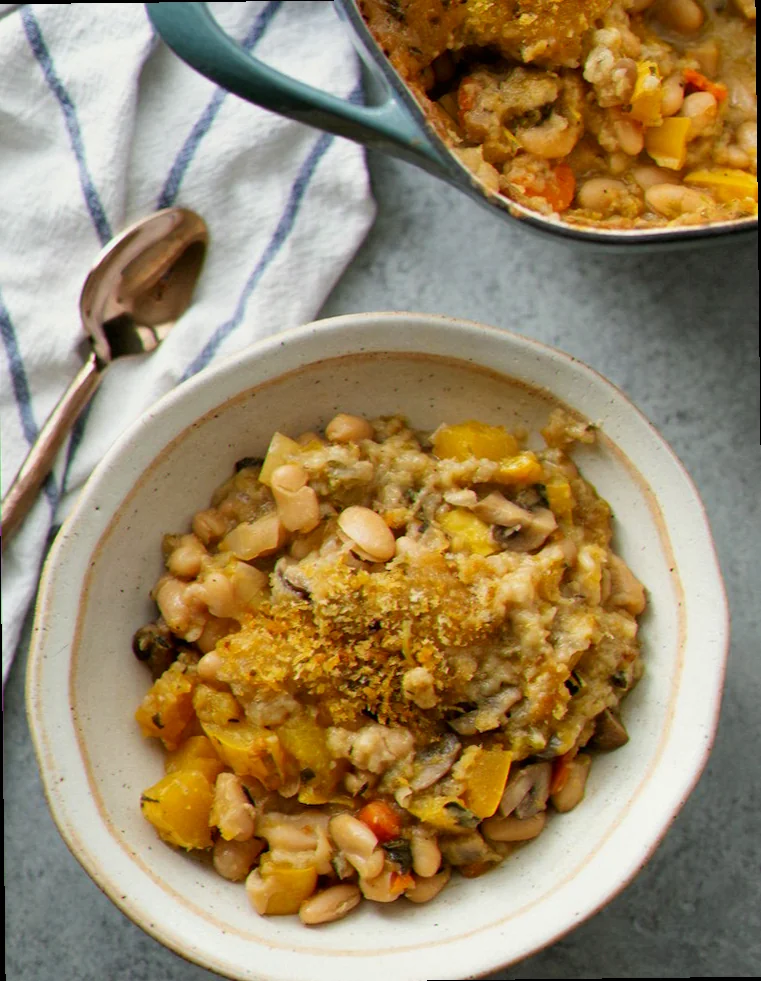
The White Bean Stew That Outlived Empires: A Vegan Cassoulet’s Hidden History
The kitchen of a 14th-century peasant home in Castelnaudary, Occitanie. A woman—her hands rough from harvesting fava beans—stirs a blackened iron pot suspended over a low fire. Outside, the wind howls across the Languedoc plain, carrying the scent of rosemary and the distant threat of war. She layers the beans with scraps of salted pork, the only meat her family will taste for weeks. This is not a feast. It is survival, rendered edible. The dish has no name yet, but in three centuries, it will be called cassoulet—first a peasant’s insurance against famine, then a bourgeois obsession, and finally, in a Brooklyn apartment in 2007, a vegan manifesto.
Where Vegan Cassoulet Comes From—and Why the Original Was Never Vegan
The cassoulet was born in the pays de Cocagne—the “land of plenty”—a sarcastic medieval nickname for the fertile but politically volatile region between Toulouse, Carcassonne, and Castelnaudary in southern France. The dish emerged in the late Middle Ages as a solution to three problems: how to preserve meat in a land without refrigeration, how to stretch beans (a New World crop not yet arrived) into a filling meal, and how to feed an army—or a rebellion.
The original cassole (the pot, not the dish) was a conical earthenware vessel designed to cook slowly in the embers of a hearth. Its contents were a reflection of what was available: fava beans (the only legume that thrived in the poor soil), confit of duck or goose (a method of preserving meat in its own fat, perfected by Jewish and Catholic communities alike), and scraps of pork (from the salted hams that sustained armies). The Cathars, a heretical Christian sect persecuted in the Albigensian Crusade (1209–1229), may have eaten an early version—beans simmered with whatever meat they could hide from marauding soldiers. By the 17th century, the dish was a staple of Occitan cuisine, a defiant cultural marker in a region forcibly absorbed into France.
When the haricot blanc—the white bean—arrived from the Americas via Spanish traders in the 16th century, it revolutionized cassoulet. Unlike fava beans, which required tedious peeling, the haricot was tender, creamy, and absorbed flavors like a sponge. The dish evolved from a peasant gruel to a bourgeois status symbol, its richness a display of wealth in a land where meat was still scarce. By the 19th century, the Confédération du Cassoulet in Castelnaudary was debating its “true” recipe—a debate that continues today, though no one then could have imagined a version without meat.
The Ingredients as Historical Artefacts
White Beans (Haricot Lingot) — The New World’s Gift to Old Europe
The haricot lingot, a flat, elongated white bean, is the soul of cassoulet. It arrived in France via Spanish conquistadors, who brought it from Mexico in the 1500s. Before this, Europeans relied on fava beans (Vicia faba), a crop domesticated in the Middle East 8,000 years ago. Favas were hardy but labor-intensive; the haricot was a revelation. By the 18th century, the bean fields of Languedoc had converted entirely, and cassoulet became a dish of the New World’s bounty, cooked in the Old World’s defiance.
Substituting cannellini or navy beans changes the texture—lingots hold their shape while absorbing liquid, creating a stew that is both brothy and thick, a balance the Occitans called “ni trop clair, ni trop épais” (neither too clear, nor too thick).
Duck Confit — A Jewish and Catholic Preservation Hack
The technique of confiting meat in fat originated with Medieval Jewish communities in southwestern France, who used it to preserve kosher poultry. Catholics adopted it for goose and duck, especially in the foie gras regions of Périgord. The fat acted as a seal against bacteria, allowing meat to last for months—a critical innovation in a region where winters were harsh and fresh food scarce.
In vegan cassoulet, mushrooms or seitan confit replace the duck, but the method remains: slow-cooking in fat (now oil) to create a caramelized, unctuous texture that mimics the original’s luxury. The loss is historical—confit was a technology of survival—but the gain is a dish that no longer relies on animal suffering.
Toulouse Sausage — The Pig That Built an Empire
The saucisse de Toulouse, a coarse pork sausage flavored with garlic and black pepper, was a byproduct of the salted pork industry that fueled France’s naval and military expansion. Pigs were fed on chestnuts and whey, their meat cured in the same salt used to preserve cod for transatlantic voyages. The sausage’s spicing reflects the spice trade routes—black pepper from India, garlic from Central Asia—now so commonplace we forget they were once rare.
Vegan versions use seitan or lentil-based sausages, but the critical factor is the fat content. Traditional saucisse is 30% fat; without it, the cassoulet loses its silken mouthfeel. The best substitutes use coconut oil or cashew cream to replicate this indulgence.
Breadcrumbs — The Crusaders’ Legacy
The golden crust on cassoulet is a relic of the Crusades. Returning soldiers brought back the Arab technique of panade—thickening stews with bread. In Occitania, this became the chapelu—a breadcrumb topping that seals in moisture while creating a crisp lid. The crust is broken ceremonially at the table, a ritual called “casser la croûte” (breaking the crust), symbolizing shared abundance.
The Ritual of Cassoulet — A Dish for Siege and Celebration
Cassoulet was traditionally eaten in three contexts:
- Harvest festivals (Fête des Vendanges), where it was cooked in enormous copper cauldrons over open fires, feeding entire villages.
- Weddings, where the bride and groom would stir the pot together as a symbol of unity (a ritual still practiced in some Occitan families).
- Times of war or siege, when its high calorie density and long shelf life made it a lifeline.
The dish’s slow cooking time (6–8 hours) was practical: it allowed women to tend to other tasks while the fire did the work. The layering of ingredients—beans, meat, crust—mirrored the social stratification of Occitan society, with the richest flavors at the bottom, revealed only when served.
In vegan cassoulet, the ritual remains, but the meaning shifts. Breaking the crust is no longer about revealing hidden meat but about celebrating abundance without exploitation. It’s a dish that now asks: What does tradition owe to the future?
How Brooklyn and Berkeley Changed Cassoulet Forever
The vegan cassoulet is a child of 21st-century diaspora and activism, born in two key migration hubs:
Brooklyn, NY (2000s) — The Punk Rock Reinvention At MooShoes, a vegan shoe store and café in the Lower East Side, chefs experimented with seitan confit and smoked tofu as substitutes for duck. The goal wasn’t authenticity but defiance—proving that French peasant food could be plant-based. The result was heavier on smoke and umami than the original, reflecting New York’s love of bold flavors.
Berkeley, CA (1990s–2000s) — The Fermentation Revolution At Millennium Restaurant, chefs used miso and tempeh to replicate the depth of confit. The influence of Japanese and Indonesian fermentation techniques (brought by West Coast hippie and Buddhist communities) gave the dish a funky, savory complexity the French original lacks.
What was lost? The subtle animal fat richness that defines traditional cassoulet. What was gained? A dish that challenges the idea of French cuisine as inherently meat-centric.
How to Make Vegan Cassoulet — The Recipe in Full
This version is rooted in Occitan technique but reimagined for a global pantry. The key is layering textures: creamy beans, chewy “meat,” and a shattering crust.
| Ingredient | Quantity | Why It’s Here |
|---|---|---|
| Haricot lingot beans | 500g (dried) | The New World legume that replaced fava beans; holds shape but absorbs flavor. |
| Duck-style seitan | 300g | Replaces confit; must be braised in oil to mimic fat rendering. |
| Toulouse-style vegan sausage | 4 links | Coarse texture echoes pork sausage; black pepper is non-negotiable. |
| Tomato passata | 400ml | Added in the 19th century after tomatoes arrived from the Americas. |
| White wine | 250ml | Acid cuts richness; use a dry Occitan white (like Picpoul) if possible. |
| Garlic | 8 cloves | Languedoc was a major garlic producer; do not skimp. |
| Rosemary + thyme | 4 sprigs each | Garrigue herbs, foraged from the scrubland where cassoulet was invented. |
| Panko breadcrumbs | 150g | Modern substitute for stale bread; toasted in olive oil for crust. |
| Smoked paprika | 1 tsp | Replaces smoked pork; a Spanish influence via the Basque Country. |
Method
1. The Beans — A 24-Hour Commitment Soak the haricot lingots overnight in cold water with a pinch of baking soda (this softens their skins, a trick from Provençal grandmothers). Drain, then simmer in fresh water with 2 bay leaves, 1 onion (studded with 2 cloves), and a strip of kombu (a Japanese addition that adds umami depth) for 1 hour, until tender but not falling apart. Reserve the cooking liquid—this is your stock, the base of the stew.
2. The Confit — Faking Fat Cut the seitan into large, irregular chunks (mimicking torn duck confit). In a heavy pot, heat 100ml olive oil until shimmering (160°C). Add the seitan and cook on low for 45 minutes, turning occasionally, until the edges crisp and the oil takes on a golden, meaty hue. This is not frying—it’s confiting, a slow render that infuses the oil with flavor. Remove the seitan; reserve the oil.
3. The Sausage — The Illusion of Pork Prick the vegan sausages and pan-sear in the confit oil until browned. Slice into thick rounds. The charred edges are critical—they replicate the Maillard reaction that gives traditional cassoulet its depth.
4. The Stew — Building Layers In the same pot, sauté 2 diced onions, 4 minced garlic cloves, and 2 diced carrots in the confit oil until soft. Add 1 tbsp tomato paste and cook until it darkens (this is the pincage, a French technique to deepen flavor). Deglaze with white wine, scraping up browned bits. Add the passata, herbs, smoked paprika, and cooked beans. Simmer for 30 minutes, adding reserved bean stock as needed. The stew should be thick enough to suspend the beans—not soupy.
5. The Assembly — A Tower of Texture In a deep, oven-safe dish (traditionally earthenware, but a Dutch oven works), layer:
- 1/3 of the beans
- Half the seitan and sausage
- Another 1/3 of beans
- Remaining seitan and sausage
- Final 1/3 of beans Press down gently. The layers ensure every bite has contrast.
6. The Crust — The Ritual Seal Mix panko with 2 tbsp confit oil and a pinch of salt. Spread evenly over the beans. Bake at 150°C for 2 hours, then broil for 5 minutes to crisp the crust. The slow bake melts the layers together; the broil creates the golden chapelu.
7. The Breaking — The Moment of Truth Bring the cassoulet to the table unbroken. Use a spoon to crack the crust—this releases steam and mingles the textures. Serve with a sharp green salad (to cut the richness) and cornichons (a nod to the pickles that accompanied medieval meat).
The Tension — Can You Call It Cassoulet Without Meat?
Purists (like the Confrérie du Cassoulet de Castelnaudary) argue that duck fat is irreplaceable—that its melting point and flavor compounds cannot be replicated. They’re not wrong. But their definition ignores how cassoulet has always adapted:
- Fava beans → white beans (New World exchange)
- Pork → duck (regional preference)
- Hearth cooking → oven baking (industrialization)
The real tension isn’t meat vs. plants—it’s whether a dish can evolve without losing its identity. The vegan cassoulet loses the animal fat’s mouthfeel but gains a lighter, brighter profile, where the beans and herbs shine.
The most authentic cassoulet is the one that feeds a community. If that community is now global and plant-based, why should the dish remain static?
What Vegan Cassoulet Has Become — A Dish for the Next Hundred Years
Today, vegan cassoulet is:
- A staple of activist potlucks, where it’s served as a rebuke to French culinary elitism.
- A menu item at high-end vegan bistros (like Cadre in Berlin), where it’s paired with natural wine.
- A viral TikTok recipe, often made with store-bought vegan sausage and canned beans—a far cry from the 24-hour original, but no less meaningful.
Its popularity reflects a larger shift: the decolonization of French cuisine. Just as cassoulet once absorbed tomatoes and white beans from the Americas, it now incorporates tofu from East Asia, smoked paprika from Hungary, and fermentation techniques from Japan. The dish has always been a collage of conquest and survival. Its vegan iteration is just the latest chapter.
Related topics: Vegan curry mee recipe · Vegan pumpkin spice drink recipe · Vegan asian recipe book
In the end, cassoulet—whether meat or plant—is a story of resistance. The peasants of Languedoc cooked it to outlast war and famine. Today’s cooks make it to outlast a different kind of siege: climate collapse, industrial farming, the myth that tradition must be static.
And so the crust is broken again. The